

Building Professor Calculus’ TV - with a Little Help from AI
Updated: Oct 4
Turning a machine drawn in a Tintin comic into a working scale model.
I am a huge Tintin fan.
This has generally been a harmless condition. I have the books, bits of Tintin memorabilia, and an enduring affection for the extraordinary amount of character Hergé could put into a few deceptively simple comic frames.
Every once in a while, however, being a Tintin fan produces a project.
This one began with Professor Calculus’ television in The Castafiore Emerald.

© Hergé/Tintinimaginatio – 2026
There is something wonderful about the machine. It has a large screen, a meter sitting on top, cables emerging from everywhere, a concertina-like bellows at the back, an improbable collection of boxes and brackets, and a stand made from perforated metal sections.
It looks less like a television designed by an electronics company and more like something Professor Calculus had assembled in his laboratory shortly before lunch.
I wanted one.
Not a replica in the strict sense - there isn't enough information in a comic panel for that - but a three-dimensional interpretation that stayed as faithful as possible to Hergé's drawing.
And if I was going to make the television, I thought it might as well actually work.
That was roughly when a fairly innocent scale-model project began getting out of hand.
The comic was the drawing
There are no engineering plans for Professor Calculus' TV.
No dimensions. No rear elevation. No helpful exploded diagram showing what Hergé imagined was happening inside the bellows.
We had essentially one drawing.
So we made a rule very early in the project: the comic would remain the visual authority.
We went back to it constantly.
Not only for obvious things such as the overall proportions of the TV, but for surprisingly small decisions - how far a frame should project, where the rear box should sit, the proportions of the bellows, the position of the meter, the apparent thickness of something, the spacing of holes, even whether a part was beginning to look too elegant.
That last point mattered.
I didn't want to turn Hergé's machine into a beautifully resolved modern industrial design. The slightly crude, experimental quality of the original is part of its charm. It needed to look engineered, but not product-designed.
Professor Calculus was allowed to have made some unusual choices.
CAD without doing the CAD
I have fairly good experience with CAD, but I decided to approach this project differently.
I would design the object, but I would let ChatGPT do the actual CAD work.
The distinction became quite important.
I would describe a part in text, give dimensions and constraints, sometimes provide a rather rough sketch, and ask ChatGPT to create the geometry. I would inspect the result, compare it with the comic, print it, fit it against the other parts, measure whatever wasn't right, and then give another set of instructions.
Some instructions were broad:
“Make the rear housing feel closer to the object in the comic.”
Others became considerably less philosophical:
“Move these holes 2 mm outward. Do not change the wall thickness. Preserve the rear datum. Do not touch anything else.”
The second kind tends to produce better engineering.
Most of the work was done with ChatGPT using Sol 5.5, with Astra 6.0 brought in at a few stages.
Over time we developed a fairly disciplined system. Designs were provisional while they were being worked on. Once I had physically printed, tested and accepted a part, it could become frozen. Future revisions had to derive from that accepted version without quietly changing anything else.
This may sound like rather serious configuration management for a television that is only about 12 cm wide.
It was.
It was also necessary.
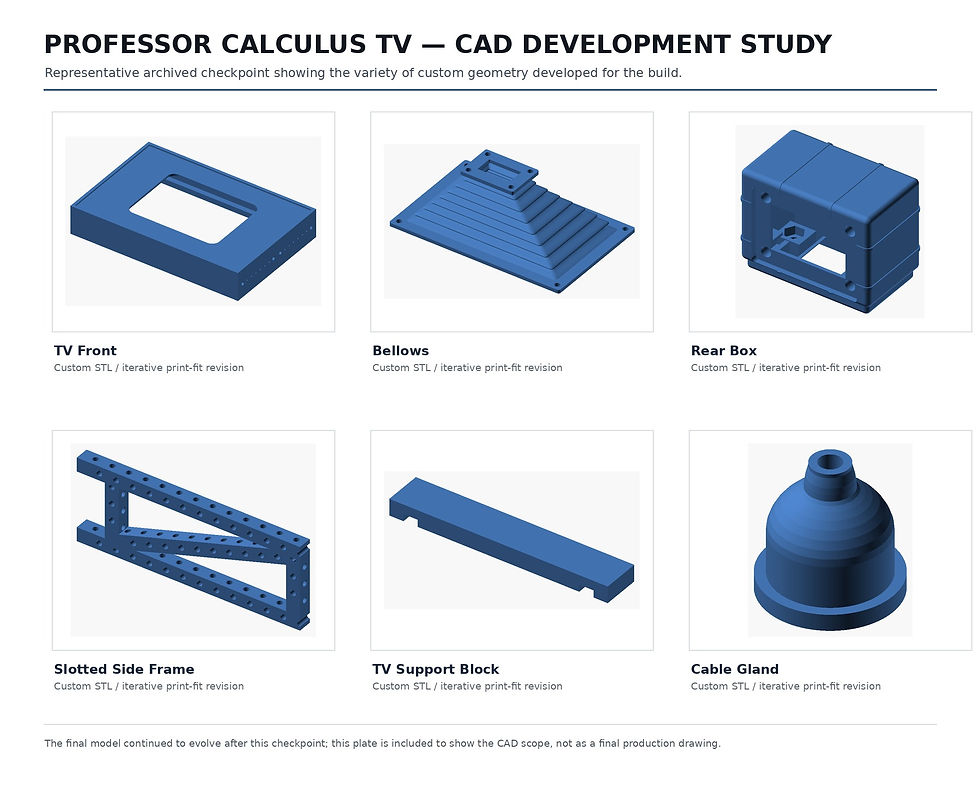
A project like this very quickly becomes interconnected. Move one hole and suddenly another piece no longer fits. Increase one wall thickness and the screw you selected is now too short. Improve the shape of something and discover that it has occupied the space where a cable has to pass.
AI is extremely good at producing and revising geometry, but it is even more useful when you can tell it precisely what must change and, equally importantly, what must not change.
That became my main job on the CAD side: define the intent, constrain it, inspect the result, and be sufficiently annoying about the details.
It worked rather well.
No glue
There was another rule I imposed fairly early.
I didn't want to glue the model together.
I wanted it not only to look like a little industrial machine, but to assemble like one.
So the structural assembly uses only M2, M3 and M4 machine screws, along with threaded heat-set inserts, locating pins, sockets, flanges and other mechanical features.
Parts can be dismantled.
The television can be removed from its stand. The bellows and rear housing can be separated. The speaker can be opened. Panels can come off. Electronics can be reached again.
This made the design considerably more complicated than printing a collection of shells and reaching for the epoxy, but it also made the finished object much more satisfying.
It feels like equipment.
Serviceability was part of the brief from the beginning because I knew that the other half of the project - the electronics - would eventually be hiding underneath all this carefully painted plastic.
And electronics, in my limited experience, has an uncanny ability to work faultlessly until access to it becomes inconvenient.
The part I knew rather less about
The electronics side was different.
I have very little experience with electronics.
Here, ChatGPT was my sole guide.
We started with an ESP32-S3 microcontroller and a small colour TFT display.
At first, getting an image onto the screen felt like sufficient ambition.
Then came reading files from a microSD card.
Then video playback.
Then audio.
Then getting the audio and video to start together.
Then an amplifier and speaker.
Then the push button.
Then the LED.
Then USB-C power.
Then arranging all of this so that pressing one button on the finished television would make the whole thing behave like a television rather than an experimental collection of circuit boards.
ChatGPT planned the wiring with me, wrote and revised the software, explained what I should connect where, suggested tests, interpreted the results and helped troubleshoot problems as they appeared.
I was effectively learning the electronics as I built it.

The video is stored on a microSD card and played on the little 320 × 240 screen.
We eventually settled on 12 frames per second.
Higher frame rates worked, but somehow looked too good.
Professor Calculus’ television seemed happier with slightly less competent video.
So for perhaps the first time in my life I spent time engineering a system and then deliberately reduced its performance because the result looked better.
When the television became a television
There was a point during the electronics development when the screen was playing Tintin footage on my bench, accompanied by sound from a separate speaker, with circuit boards and jumper wires scattered around it.
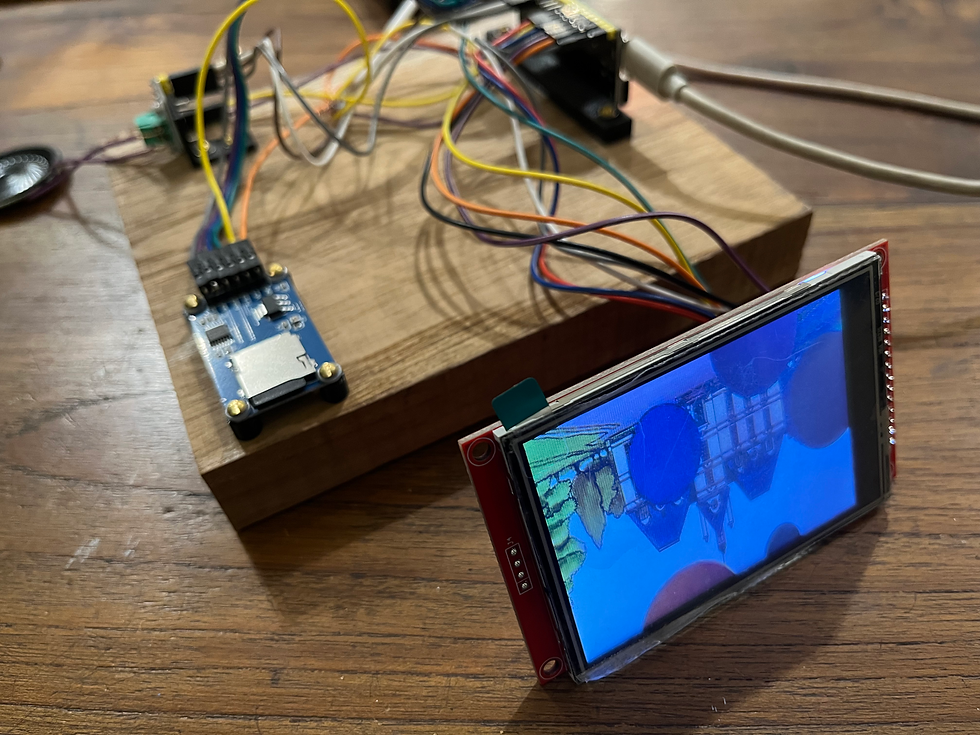
It was still nowhere near being the finished object, but that was probably the first moment when the project stopped being a collection of parts and became recognisably the television.
It was also around this stage that some of the more educational electronic problems arrived.
At one point I could press the button and hear the audio perfectly while the screen remained completely white.
Moving the display and its wires around could provoke the fault. Resetting the ESP32 could make it disappear.
I described the symptoms to ChatGPT, we worked through possible causes, and eventually I replaced one of the ground jumper wires.
The problem disappeared.
There are moments when one imagines the future of AI-assisted engineering as something involving autonomous laboratories and astonishing new materials.
And then there are moments when the AI helps you discover that you have a bad jumper wire.
Both are useful.
From a drawing to a collection of objects
Meanwhile, the mechanical side kept growing.
Every custom plastic part in the model was 3D printed in PLA+ on my Bambu Lab A1. By this stage the printer had become less a tool and more a minor member of the project team.
The TV shell was printed.
The bellows was printed.
The rear housing was printed.
The perforated side frames were printed.
There was a support block, cable glands, a bench, a meter housing, locating pins and various small pieces that made no particular sense when seen by themselves.
Most parts went through several revisions.
Some went through rather more.
The bellows in particular attracted a disproportionate amount of attention for an object whose principal function is to sit behind another object and be black.
Its shape changed. Its geometry changed. The way it fitted the rear box changed. The mounting arrangement changed. Versions were printed, tested and discarded.
Every time we changed something substantial, we went back to the comic again.
That repeated loop became the basic method of the entire project:
Look at comic → describe → model → print → assemble → measure → complain → revise.
There was quite a lot of the seventh step.

Because the CAD was being generated through conversation, I found that photographs became surprisingly useful engineering documents. I could photograph an actual assembly, point out what was wrong, give measurements from the physical part and ask ChatGPT to modify the geometry while preserving everything else.
The virtual design was continually being corrected by the physical object.
This is one reason I think AI is particularly interesting for projects of this kind. The AI doesn't need to inhabit the physical world itself if you can act as its eyes, hands, calipers and occasionally its quality-control department.
The speaker Hergé forgot to design
There is no separate speaker beside the television in Hergé's drawing.
I needed one anyway.
The little speaker inside the final model had to live somewhere, and simply hiding a modern speaker enclosure behind the scene felt like a wasted opportunity.
So we designed one.

The brief was deliberately loose compared with the rest of the project. It had to look as though it belonged in the same world as the television: rugged, black, slightly over-engineered and with the feeling of 1950s laboratory or communications equipment.
We ended up with a small rectangular enclosure with a grille and a horn on top.
Since Hergé had neglected to provide us with this particular accessory, there was nobody to argue with.
It too was designed for mechanical assembly rather than glue, around the actual loudspeaker driver inside it.
I rather like the result. It isn't canon, but I think Calculus could plausibly have had one.
Making it all fit on one board
The wooden baseboard became almost a project within the project.
Above it had to sit the complete visible scene: television, stand, rear bench, bellows, speaker and Professor Calculus.
Below it lived the less picturesque part: ESP32, amplifier, storage, power distribution and wiring.

The two worlds had to coexist.
Every screw coming down from above had consequences underneath. Every cable emerging from the electronics had to arrive somewhere useful above. Mounting positions had to allow the system to be assembled and, importantly, dismantled again later.
By now the original requirement of “no glue” was making perfect sense.
Or at least I had become too committed to it to admit otherwise.
Paint helps
Freshly printed PLA has a very particular appearance.
It says 3D printer rather more loudly than it says Professor Calculus' laboratory.
So after the mechanical work was finally settled, the pieces were sanded, primed and painted.

The bellows became matte black. The perforated frames became silver-grey. The support block was brown. The cable glands were white. The meter shell was glossy black. The speaker was matte black.
The teak base was finished separately with Danish oil.
Paint transformed the model more than I expected. Shapes that had looked like obviously separate 3D prints began to read as pieces of one machine.
The objective wasn't to make the model look factory-perfect. Quite the opposite, really.
It just needed to stop looking as though it had left the printer twenty minutes earlier.
What I learned about working with AI
The finished television is obviously a Tintin project, but for me it also became an unusually practical experiment in AI-assisted making.
The two halves tested AI in rather different ways.
On the electronics side, I was working outside my own area of experience. ChatGPT acted as teacher, engineer, programmer and troubleshooter. Without it, I doubt I would have attempted the electronics in this form at all.
On the CAD side, I understood the engineering but deliberately delegated the actual modelling. That made the project an experiment in how accurately I could communicate design intent to an AI.
The biggest lesson from that side was that prompting a serious project is less about finding some brilliant sentence and more about being able to specify.
What are the dimensions?
What is the reference surface?
Which feature is fixed?
How much tolerance do we need?
Where must the screw be accessible?
What must remain unchanged from the previous version?
What exactly is wrong with the part sitting in front of me?
You have to know what you want well enough to recognise when you haven't got it.
A physical project is particularly unforgiving in this respect.
A generated paragraph can sound convincing.
A generated image can look convincing.
A 3.4 mm hole is either 3.4 mm or it isn't.
A bolt either enters the threaded insert or misses it.
There isn't much room for rhetoric.
That makes the collaboration interesting. ChatGPT could produce CAD geometry, reason about assemblies, write software, diagnose circuits and keep track of a surprisingly large number of design decisions. I supplied the intent, constraints and physical feedback, made the engineering decisions and tested every consequence in the real world.
The object emerged somewhere in that loop.
And here it is

The finished model has a working colour screen, video and sound, a push-button control, indicator light, separate speaker and the various bits of slightly mysterious apparatus that surround the television in the original drawing.
Professor Calculus is supposed to stand in front of the model, pointing at his invention. Someday he will.
Looking at it now, the part I enjoy most isn't really the screen, or the bellows, or even the fact that the thing works.
It is the chain of translations that produced it.
A line in a Tintin panel became a measurement.
A measurement became an instruction.
An instruction became CAD.
CAD became a print.
A print became a physical test.
The physical test became another instruction.
Meanwhile, an electronics question became a circuit, a circuit became software, the software produced another problem, and the problem became another conversation.
Eventually, after enough trips around that loop, there was nothing left to discuss.
Professor Calculus had his television.
And, rather unnecessarily but very satisfyingly, it actually works.
The finished TV can be seen working here:
This is an unofficial fan-made project and is not affiliated with or endorsed by Tintinimaginatio.
Credits:
I won't have attempted this project if I hadn't seen the incredible scale-model made by STROBEZ. His is a more elaborate, and a more beautiful diorama imo, complete with figures of Tintin and his friends, and of professor calculus pointing at his invention. He also generously shares his creation process in his well maintained blog which is full of scale models from the Tintin universe and from his other loves.


Comments